Data, documents & responsibilities
Your records.
Ready for 2027.
What changes in 2027 for German e-invoices and payroll records, which time-recording duties already apply, and how to retain documents and export your data.
Understand the 2027 deadlinesGermany · Updated 15 October 2026
At the turn of the year
What changes when 2027 begins?
Three important topics for your business. Each answer includes the details and official sources.
- E-invoicesNext stage from 2027 With total turnover above 800,000 euros in 2026, the next stage of mandatory e-invoice issuance applies to domestic B2B transactions within scope. At no more than 800,000 euros, the transition continues until the end of 2027; exceptions apply.
- Electronic payroll recordsExemption period ends The option to obtain an exemption from keeping electronic payroll records ends at the turn of the year. This concerns certain payroll and social-insurance records, rather than a blanket duty to keep digital personnel files.
- Working-time recordingRecording is already required Working time must generally already be recorded. The currently published guidance does not establish a general duty for everyone to record it electronically from 1 January 2027.
The legal information on this page concerns Germany. It provides general guidance; other countries and individual circumstances have their own rules.
Data & documents
Storage, retention and exports
Where is my data stored and who can access it?
QuickQuote uses encrypted transmission and role-based access. The database and server-side functions are configured in European regions. Individual services may also process data outside the EU. The Privacy Policy and Data Processing Agreement describe the providers involved and the safeguards.
How long must I keep invoices in Germany?
Incoming and outgoing invoices generally have to be kept for eight years, starting at the end of the calendar year in which they were issued. Longer periods may apply in individual cases. For e-invoices, at least the original structured data must remain unchanged. A printout or just the readable PDF view is not enough.
Source: Section 14b of the German VAT Act; German Ministry of Finance, e-invoice retention
Does the same retention period apply to quotes?
Different records have different retention periods. Quotes may qualify as commercial or business correspondence and generally need to be kept for six years. The type and purpose of the record matter. Accounting vouchers and other tax records may have different periods.
Source: Section 147 of the German Fiscal Code, paragraphs 1, 3 and 4
What can I export from QuickQuote today?
The owner can create a business export as a ZIP file. It includes JSON data from the available areas, CSV files for key lists and notes about omitted areas. PDFs, photos and other attachments are not included, only their names and references. Download and save the original files you need separately.
There is also a profile or workspace export as JSON. On the same device and account, this can be retrieved again 30 days after saving. Timesheets and monthly summaries can be exported separately as PDF. A data export alone does not replace a complete document archive.
Can QuickQuote automatically send documents to my archive email or server?
These additions are planned and are not yet available. The plan includes an archive package containing document files, additional copies sent to an archive email address and a local archive folder on the office computer. A Windows archive agent is planned for a later stage, to save files on the company server or a NAS share. WebDAV and SFTP are planned as alternative destinations. There is no confirmed release date.
QuickQuote will remain a cloud app. The first step is additional file copies held by the business, without deleting the files in the cloud. This does not mean a fully self-hosted version of QuickQuote.
Today you can download documents and save them in your own filing system. The existing business export contains data and file references, rather than all original documents. An email mailbox or server folder alone does not guarantee compliant record retention.
E-invoicing
German requirements and current app support
Is every invoice PDF an e-invoice?
No. An e-invoice contains structured data that can be processed electronically. A plain PDF without this data is a different type of invoice. XRechnung and suitable ZUGFeRD profiles are common e-invoice formats.
Source: Section 14 paragraph 1 of the German VAT Act; German Ministry of Finance, e-invoice formats
Does my business already need to be able to receive e-invoices?
Since 1 January 2025, businesses based in Germany must be able to receive e-invoices, including businesses using the German small-business VAT exemption. An email mailbox is sufficient for receipt. You must arrange further processing and retention of the original separately.
When must I start issuing e-invoices?
From 1 January 2027, businesses with total turnover above 800,000 euros in the preceding year must issue e-invoices for domestic B2B transactions within scope. For 2027, the preceding year is 2026. At no more than 800,000 euros, the transition continues until 31 December 2027. Certain EDI procedures also have a transition period until the end of 2027. From 2028, the requirement generally applies to all transactions within scope.
Exceptions include businesses using the German small-business VAT exemption, invoices of up to 250 euros including VAT and many VAT-exempt transactions. Public-sector customers have separate rules.
Source: Section 27 paragraph 38 of the German VAT Act; German Ministry of Finance, transition rules and exceptions
Which e-invoices does QuickQuote support today?
For suitable finalised business invoices, QuickQuote Pro can create a ZUGFeRD/Factur-X PDF with embedded invoice data using the EN 16931 profile. The required business, customer and invoice details must be complete. Private customers receive a normal PDF.
For supplier invoices, QuickQuote can read structured data from suitable ZUGFeRD/Factur-X PDFs. Uploading standalone XML files, such as an XRechnung, is not yet enabled. National systems such as KSeF, e-Factura and SdI, and the Swiss QR-bill, are not connected. Check your recipient’s requirements before sending.
Working time & personnel
Time tracking, monthly summaries and payroll records
Will digital time tracking be mandatory for everyone from 1 January 2027?
The general duty to record all working time already exists in Germany. According to the currently published guidance from the Federal Ministry of Labour, electronic recording is not generally required yet. Legislation requiring electronic recording is planned. This does not currently establish a blanket requirement for everyone from 1 January 2027.
Source: German Ministry of Labour, working-time recording FAQs
Will digital personnel files become mandatory in 2027?
The specific deadline concerns electronic payroll records: the exemption available under section 8 paragraph 3 of the German Contribution Procedure Regulation ends on 31 December 2026. It covers certain records relevant to payroll and social insurance, including mandatory working-time records under the German MiLoG or AEntG where applicable. Keeping those records electronically is distinct from a general duty to record all working time electronically. It does not create a blanket duty to keep the entire personnel file digitally.
Source: Section 8 BVV, current text published by German Pension Insurance
How does QuickQuote support time tracking and payroll preparation?
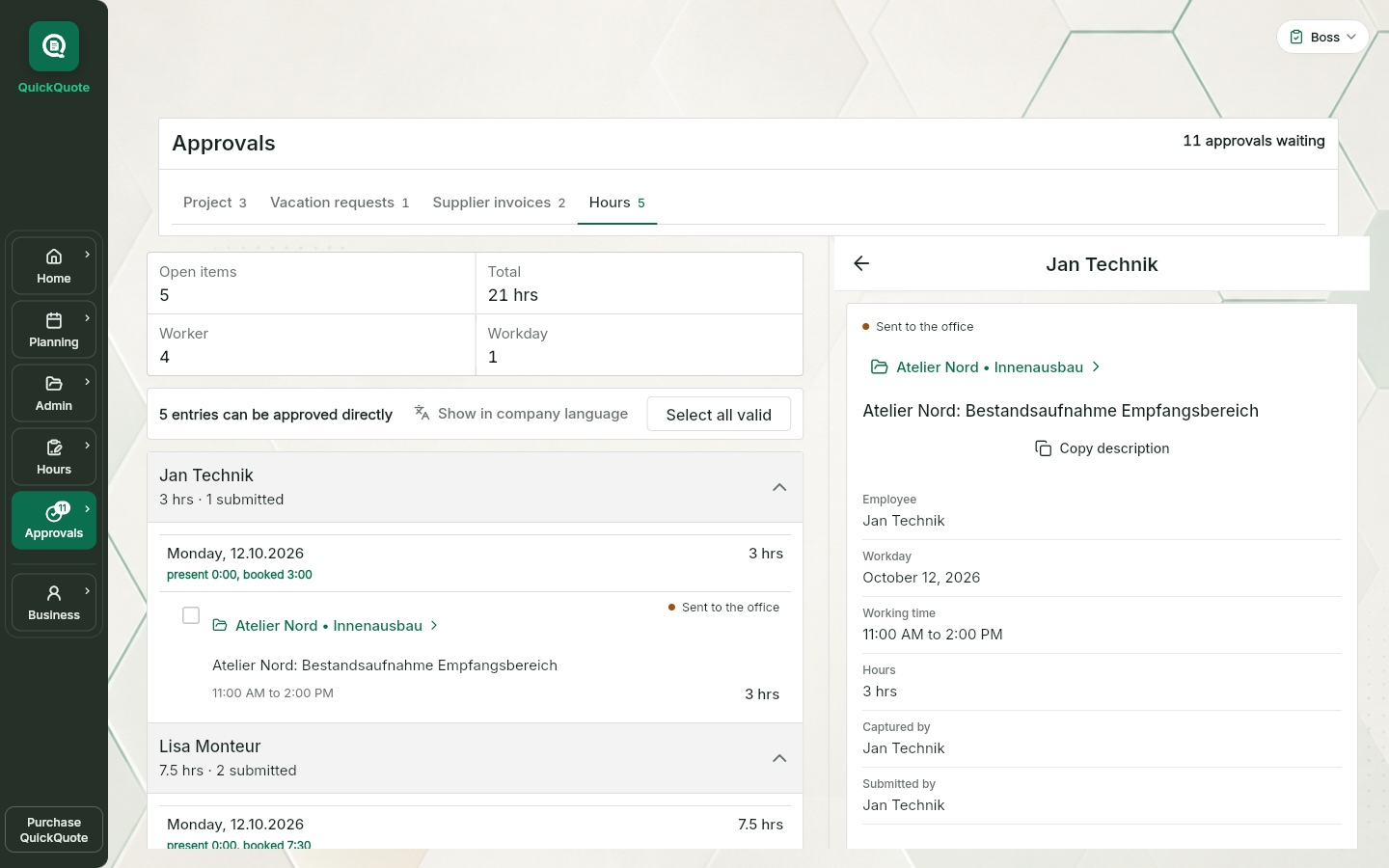
QuickQuote provides project hours, timesheets, absences and a clock for recording arrival and departure. Staff can clock in using the app on the company network or a tablet with a personal PIN. Compatible Datafox terminals can transmit records in HTTP mode; the office can import other existing records from a file.
An invited payroll-office user can view closed monthly summaries including daily figures, absence types and correction rows and export CSV or PDF. This is not payroll processing or a complete digital personnel file. Direct DATEV payroll exports are not yet enabled. See pricing for the features included in your access.
Another question about your records?
Tell us which documents you want to manage and which output you need.
App views use this language. Example names, project data and sample PDFs may remain in German.